For global buyers, choosing the right Children Wooden Puzzles requires more than attractive colors and clever shapes. The 2026 market is moving toward safer materials, clearer documentation, and designs that support meaningful early learning. Buyers are examining wood quality, finish durability, age suitability, packaging efficiency, and supplier consistency before placing larger orders.
This guide introduces leading puzzle options for retailers, distributors, educational suppliers, and private-label brands. It considers practical details, including smoothly sanded edges, secure puzzle pieces, readable age labels, and moisture-resistant packaging. Some products may use responsibly sourced wood or water-based coatings, but buyers should verify certificates and test reports directly with manufacturers. Requirements can differ across markets.
Small details matter.
A well-designed puzzle should fit comfortably in a child’s hands, resist frequent handling, and encourage problem-solving without unnecessary frustration. Animal scenes, transport themes, alphabet boards, and simple geographic maps remain commercially useful because they combine recognition with play. However, attractive artwork does not always prove strong educational value. Some puzzles look impressive online but feel thin, loose, or poorly finished in person.
Reliable sourcing depends on samples, factory communication, production controls, and transparent quality records. Buyers should compare piece thickness, print accuracy, odor, carton protection, and replacement policies. The best choice may not be the cheapest option. It should offer dependable quality, clear compliance support, and a realistic balance between learning value and retail cost. This overview helps global buyers review the 2026 Children Wooden Puzzles market with practical judgment and room for careful reflection.
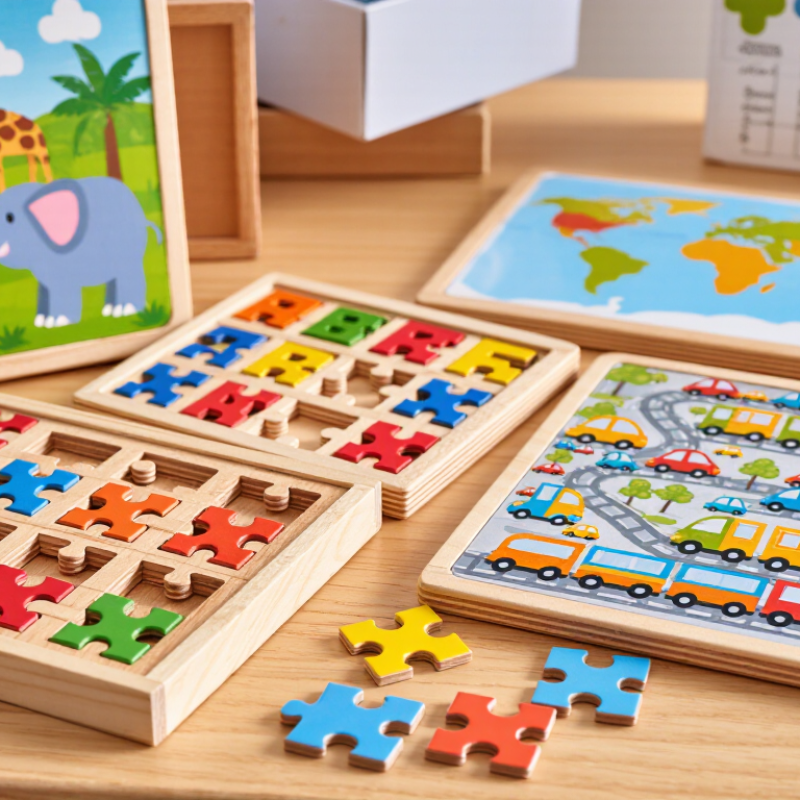
What Defines a High-Quality Children’s Wooden Puzzle in 2026
In 2026, a high-quality children’s wooden puzzle begins with material transparency. Global buyers should expect wood from documented, responsibly managed sources. The surface must feel smooth, not slippery or overly polished. A light finger rub should reveal no splinters, sharp corners, or loose paint. That simple test matters. Water-based, tested coatings can reduce safety concerns, but “non-toxic” alone is not enough. Suppliers should provide current test reports for relevant market requirements.
Good design balances challenge, grip, and learning value. Pieces need enough thickness for small hands to lift without frustration. Rounded edges help, yet they do not replace suitable age guidance. Toddler puzzles should use large pieces and clear, recognizable shapes. Older children may benefit from layered scenes, rotating parts, or early spatial problems. Fit matters too. Pieces should connect securely without requiring force. Attractive puzzles can still fail here: tight cuts may chip, while loose cuts weaken play. That flaw is easy to miss in product photos.
Reliable suppliers also control consistency across production batches. Buyers can request sample inspections, packaging details, and traceability records before larger orders. Packaging should protect corners and limit unnecessary plastic where practical. Instructions must be readable, accurate, and prepared for the destination market. A small quality issue can become expensive after shipping. Not every defect appears. Careful inspection, realistic testing, and honest communication remain more valuable than appearance alone.
Key Puzzle Types and Age-Based Learning Benefits
2026 Top Children Wooden Puzzles for Global Buyers
Key Puzzle Types and Age-Based Learning Benefits
Wooden puzzles remain practical learning tools for global buyers. UNICEF reports that about 90% of brain development happens before age five. That figure supports early, hands-on play. However, age labels should guide choice, not replace observation.
Knob puzzles suit toddlers aged 18 months and above. Large pieces strengthen grasp control and matching skills. A child can lift a wooden apple, feel its edge, and return it to the correct space. Peg puzzles add early visual planning.
For ages three to four, chunky jigsaw puzzles encourage patience and part-to-whole thinking. Shape boards also introduce circles, triangles, and simple counting. Small pieces need careful age grading.
Older preschoolers benefit from layered, map, alphabet, and sequence puzzles. These types support memory, vocabulary, spatial reasoning, and flexible thinking. The American Academy of Pediatrics links play with executive function, language development, and self-regulation.
Circana’s global toy market reporting also tracks puzzles and games as established learning-play categories, helping buyers compare demand across regions. Yet sales data cannot show every child’s experience. Some children dislike bright colors or crowded images. Others need fewer pieces and more time. That matters. A well-made puzzle should have smooth edges, stable wood, clear artwork, and realistic difficulty. Children learn through trial, including failure. Even so, adult guidance should remain calm, brief, and optional.
Safety, Materials, and Sustainability Standards for Global Markets
For global buyers, a wooden puzzle is more than a colorful learning toy. Safety begins with clear age grading and realistic skill levels. Pieces should resist breakage, splintering, and sharp edges during normal play. Smooth sanding matters, especially around handles and small corners. Paints, inks, and coatings should be tested for restricted substances and heavy metals. Suppliers should provide recent laboratory reports, material declarations, and production traceability. Testing must match the destination market. Standards such as ASTM F963, EN 71, and ISO 8124 may apply, but requirements can change. Do not rely on one certificate forever.
Tips: Request a sample before placing a large order. Check every edge by hand. Ask whether wood moisture is controlled. Review the testing laboratory’s accreditation. Keep records for each production batch. Small details expose weak quality systems.
Sustainability requires evidence, not attractive wording. Buyers can request information about wood species, legal sourcing, recycled packaging, and responsible forestry certification. Water-based coatings may reduce certain emissions, but they still need safety testing. Packaging should protect the puzzle without excessive plastic or oversized boxes. A recycled-paper box does not automatically prove responsible production. Waste rates, energy use, and worker conditions also deserve attention. No checklist is perfect. Even experienced teams can overlook a loose knob or unclear warning label. Regular factory reviews and independent inspections help turn good intentions into reliable purchasing decisions.
How Global Buyers Can Evaluate Suppliers and Purchase Options
2026 Top Children Wooden Puzzles for Global Buyers
Global buyers should evaluate more than puzzle pictures and quoted prices. Ask suppliers about wood species, moisture control, cutting accuracy, and surface finishing. A reliable supplier can provide recent safety test reports, material declarations, factory photographs, and clear age recommendations. Verify whether testing matches the destination market, such as EN 71 or ASTM F963 requirements. Do not rely on a certificate image alone. Check its issuing laboratory, validity, product scope, and sample details.
Request physical samples before placing a large order. Examine loose pieces, sharp corners, paint odor, tray strength, and print alignment. Measure the puzzle size against the supplier’s specification. Compare minimum order quantity, sampling fees, production time, packaging volume, payment terms, and shipping conditions. A low unit price can become expensive after testing, damaged cartons, customs charges, and delayed delivery. Landed cost matters more.
Tips: Create a supplier scorecard with safety, quality, capacity, communication, and total cost. Ask the factory to explain its inspection process. Details matter. Keep written approval records for colors, dimensions, packaging, and warning labels. A common mistake is trusting the first attractive sample. It may not represent mass production. Require a pre-shipment inspection when the order value justifies it, and leave room for corrective action. Perfect information is rare, so document every uncertainty before purchasing.
Conclusion
In 2026, high-quality Children Wooden Puzzles combine thoughtful design, durable construction, educational value, and reliable safety performance. Suitable puzzles should match children’s developmental stages, from simple chunky pieces that support grasping and shape recognition to more complex sets that encourage problem-solving, language development, memory, and spatial thinking. Clear illustrations, smooth edges, strong connections, and age-appropriate difficulty can make play both enjoyable and meaningful.
For global markets, buyers should carefully review material choices, non-toxic finishes, responsible wood sourcing, product labeling, and applicable safety requirements. Manufacturers should maintain consistent dimensions, accurate printing, secure packaging, and thorough quality control throughout production. When evaluating suppliers, global buyers can compare manufacturing capabilities, customization options, sample quality, production capacity, communication, documentation, and purchase terms. A dependable supplier should demonstrate transparent processes and stable quality, helping buyers select Children Wooden Puzzles that are safe, sustainable, educational, and suitable for diverse consumer markets.