Executive Overview: The Resurgence & Evolution of Children Wooden Puzzles
In an increasingly digitalized early childhood toy sector, Children Wooden Puzzles represent one of the most resilient, high-growth categories in global retail and institutional procurement. Driven by parent-led demand for tactile, screen-free learning devices and the widespread institutional adoption of Montessori and Reggio Emilia pedagogical frameworks, wooden puzzles have evolved from basic shape-sorters into complex, multi-layered cognitive instruments.
From an enterprise procurement perspective, purchasing high-volume wooden toys requires far more than aesthetic appreciation. Professional retail buyers and institutional sourcing directors must balance structural engineering—such as ply stability and veneer bonding—with strict international chemical emission standards, zero-splinter finishing techniques, and ergonomic grasp factors tailored to specific early-childhood developmental milestones.
Information Gain Insight for Global Procurement Officers
Unlike plastic toys produced through automated injection molding, natural wood exhibits anisotropic properties—expanding, contracting, and absorbing humidity differently across radial and tangential grain axes. B. toys engineers timber to a strict 8%–12% equilibrium moisture content (EMC), ensuring puzzles resist warpage, delamination, and fungal degradation during intercontinental ocean transport across varying climate zones.
Cognitive & Neurological Benefits Across Key Age Brackets
Every wooden puzzle produced under the B. toys trademark is mapped directly to childhood motor and cognitive milestones. Understanding these developmental intent triggers allows global retail buyers to curate optimized SKU assortments:
- Infants & Toddlers (Ages 12m–24m): Knobbed & Pegged Puzzles — Focuses on palmar grasp transitioning to pincer grasp, hand-eye coordination, and basic visual-spatial orientation. Large ergonomic wooden handles prevent accidental swallow hazards while building core wrist muscles.
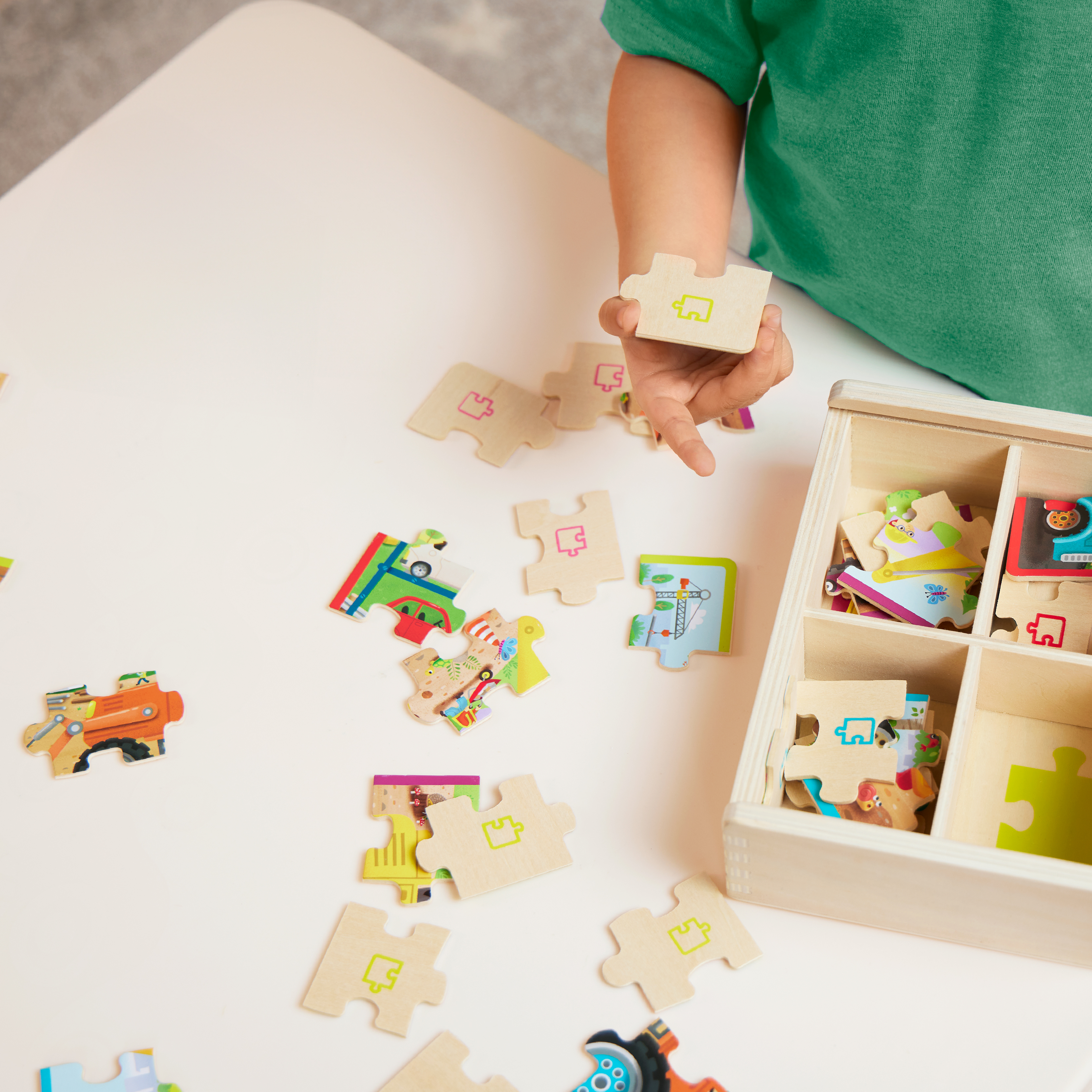
- Preschoolers (Ages 2y–4y): Layered & Self-Correcting Puzzles — Enhances visual discrimination, spatial rotation skills, tactile sensory feedback, and problem-solving resilience. Self-correcting cutouts provide intrinsic feedback, enabling independent play without requiring adult intervention.
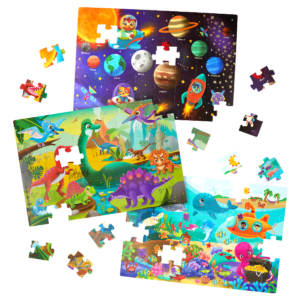
- Early Primary (Ages 4y–6y+): Multi-Piece Floor & Storytelling Puzzles — Promotes sequential thinking, narrative construction, advanced motor planning, and collaborative social play. Large-format wooden floor puzzles physically engage children, promoting core stability and gross motor refinement.
| Timber / Material Grade | Density & Durability | Warpage Resistance | Primary B2B Application | Environmental & Safety Profile |
|---|---|---|---|---|
| Solid European Beechwood | Very High (720 kg/m³) | High (Kiln-Dried 10%) | 3D Puzzle Blocks, Pegs, Frame Rails | 100% Biodegradable, FSC Certified, Non-Splintering |
| Multi-Ply Basswood Plywood | High (530 kg/m³) | Exceptional (Cross-Laminated) | Puzzle Baseboards & Inset Trays | Formaldehyde-Free E0 Structural Resin, Ultra-Flat Surface |
| FSC Rubberwood (Hevea) | Medium-High (590 kg/m³) | Moderate-High | Tactile Shapes & Chunky Figures | Upcycled Eco-Timber from Plantation Rubber Trees |
| Engineered MDF (High-Density) | Uniform Medium | Very High (In dry climates) | Budget-Tier Backing Boards | Requires CARB Phase 2 & TSCA Title VI VOC Clearance |