B. toys Blog — Play Ideas, Learning Guides & Parenting Inspiration
Choosing Toddler Balance Beams for a business involves more than comparing prices, colors, and shipping times. The right equipment must support movement, withstand repeated use, and protect small children during everyday play. The World Health Organization recommends at least 180 minutes of physical activity daily for children aged three to four, including 60 minutes of moderate-to-vigorous activity. This guidance makes balance equipment relevant to active learning, not merely playground decoration.
Safety comes first. The U.S. Consumer Product Safety Commission’s Public Playground Safety Handbook, Publication 325, highlights fall protection, entrapment risks, surfacing, and age-appropriate design. ASTM F1487 also provides performance requirements for public-use playground equipment in the United States. European buyers may reference EN 1176, which addresses structural integrity, impact areas, and equipment testing. These standards do not make every product suitable. They create a professional baseline.
In practice, buyers should examine beam height, width, edge finishing, stability, load capacity, and installation conditions. A toddler should be able to step onto the beam without climbing a steep platform. Rounded edges matter when tiny hands search for balance. Rubber or engineered wood surfacing can reduce injury severity, although no surface removes every risk. Fit matters.
Supplier documentation should include test reports, material specifications, maintenance instructions, and replacement-part availability. Market reports can offer useful purchasing trends, but figures differ by country and product definition. That limitation deserves attention. A cheaper beam may appear efficient, yet frequent repairs can increase ownership costs. Businesses should compare lifecycle value, staff supervision needs, cleaning routines, and customer expectations before ordering Toddler Balance Beams. The best choice is not always the most colorful one.
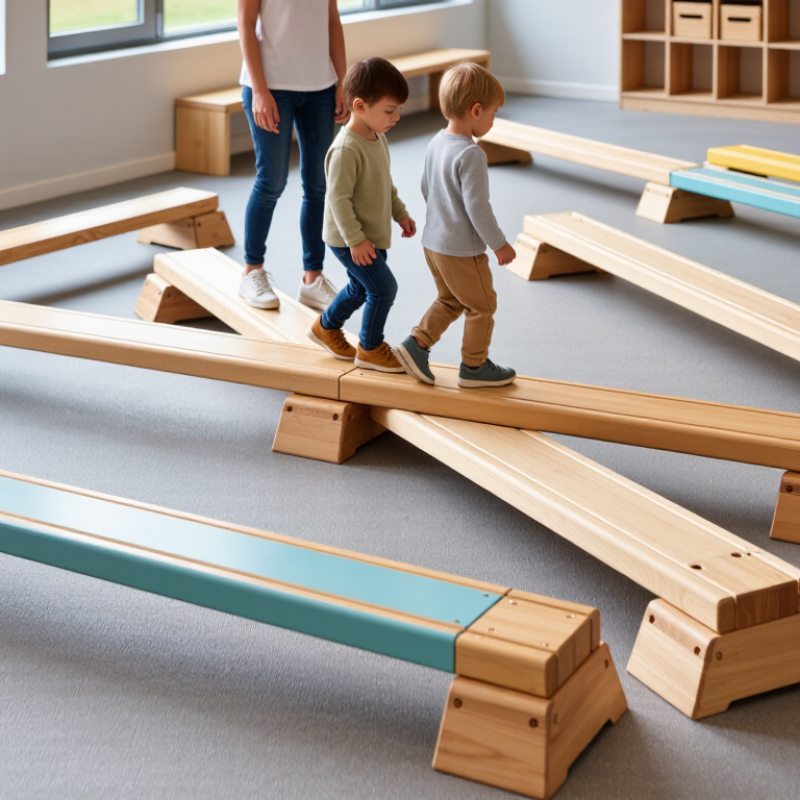
Define Toddler Age Bands and Product Use Under ASTM F963’s Toy-Safety Scope
For toddler balance beams, define the intended user before comparing dimensions or materials. A practical business segment is children aged 12–36 months, split internally into 12–23 and 24–36 months. These are planning bands, not age categories established by ASTM F963. The U.S. Consumer Product Safety Commission’s Age Determination Guidelines describe developmental differences that help inform age grading. A label alone can still mislead.
ASTM F963 defines toys as products intended for play by children under 14, but exclusions and product-specific requirements matter. A beam marketed for toddler play may be treated differently from sports equipment, playground equipment, or a therapeutic device. Confirm the product’s intended use and applicable scope before making safety claims. Check beam height, width, stability, surface grip, and edge finish against the actual play setting. Small details count. A smooth indoor floor can change how securely feet stay in place.
The CPSC’s 2023 toy-related injury report estimated 231,700 emergency-department-treated injuries involving toys among children under 15 in the United States. That figure covers many toy types; it does not measure balance-beam injuries specifically. Still, it supports careful age grading and risk review. For procurement, request test documentation tied to the exact model and intended age range. ASTM F963 compliance should not be assumed from appearance or a supplier’s general statement. It is easy to overlook that distinction.
How to Choose Toddler Balance Beams for Your Business? - Define Toddler Age Bands and Product Use Under ASTM F963’s Toy-Safety Scope
| Age band and developmental profile | Recommended business use | Practical product dimensions | Stability and accessibility features | Key safety considerations under an ASTM F963 review | Suggested labeling and documentation |
|---|---|---|---|---|---|
|
12–18 months Early walkers developing balance, stepping, and supported climbing skills. |
Closely supervised home use, toddler classrooms, and early-learning environments with an adult within arm’s reach. |
Beam length: approximately 600–900 mm Walking surface width: approximately 120–180 mm Height: approximately 25–50 mm Broad base or integrated feet recommended. |
Low profile, wide support footprint, rounded edges, high-friction contact surfaces, and a short uninterrupted walking path. Consider hand support only if it cannot create entrapment or impact hazards. | Assess stability, tipping, sharp points and edges, small detachable parts, accessible openings, pinch or shear points, impact surfaces, material integrity, and foreseeable misuse. A balance beam marketed as a child-directed play product may fall within the toy-safety scope of ASTM F963 when intended for children under 14. | State the intended age range, adult-supervision requirement, maximum user weight if applicable, indoor or outdoor limitations, setup instructions, inspection guidance, and storage instructions. |
|
18–24 months Improving independent walking, stepping over low obstacles, and directional control. |
Daycare, preschool, therapy-support activities, and supervised indoor gross-motor stations. |
Beam length: approximately 900–1,200 mm Walking surface width: approximately 100–160 mm Height: approximately 40–75 mm Modular sections may support different layouts. |
Use non-skid feet, a low center of gravity, visible contrast between the beam and floor, and connectors that cannot loosen during ordinary use. Avoid unnecessary raised transitions between modules. | Verify that joints do not expose finger entrapment points and that detachable components remain secure. Review foreseeable climbing, jumping, carrying, and sideways use. Check finishes and coatings for durability and applicable chemical or heavy-metal restrictions. | Provide age grading based on developmental suitability, assembly diagrams, maximum number of users, surface requirements, cleaning instructions, and a warning against use near stairs, water, or other fall hazards. |
|
24–36 months Developing dynamic balance, independent obstacle negotiation, and simple cooperative play. |
Preschool classrooms, indoor play areas, home playrooms, and structured motor-skill circuits with active supervision. |
Beam length: approximately 1,200–1,800 mm Walking surface width: approximately 100–150 mm Height: approximately 75–150 mm Optional interchangeable ramps or stepping elements. |
Use stable end supports, rounded transitions, textured but cleanable surfaces, and visual start-and-finish markers. Any adjustable feature should lock securely and require deliberate adult adjustment. | Evaluate fall, impact, structural-load, stability, and durability risks for the complete configuration. Confirm that moving parts, fasteners, caps, and decorative elements cannot become hazardous after repeated use. | Identify the intended age range and use environment, list required protective floor clearance, specify inspection intervals, and include warnings for simultaneous use when the product is not designed for multiple children. |
|
36–60 months Greater coordination and confidence; children may combine balancing with climbing, hopping, and imaginative play. |
Preschool movement programs, supervised commercial play spaces, and home products intended for older preschoolers. |
Beam length: approximately 1,500–2,400 mm Walking surface width: approximately 100–200 mm Height: approximately 100–250 mm More challenging layouts should be offered only with clear age grading and supervision guidance. |
Use anti-slip feet, reinforced joints, rounded corners, high-visibility markings, and optional side elements that do not create climb-over or entrapment hazards. Design for easy daily inspection and cleaning. | Treat the complete product and accessories as one foreseeable-use system. Review structural strength, stability, impact exposure, entrapment, protrusions, flammability, material safety, and label durability within the applicable ASTM F963 assessment. | Include age grading, supervision instructions, assembly and anchoring requirements, maximum load information, maintenance procedures, replacement-part guidance, and a clear stop-use instruction for damaged components. |
|
All toddler and preschool versions Age grading should reflect the youngest intended user and the most demanding foreseeable use. |
Select the configuration according to location, supervision level, traffic volume, cleaning routine, and whether the product is sold as a toy or as commercial play equipment. | Prefer dimensions that match the target users’ abilities rather than using one size for every age. Document tolerances, load assumptions, floor conditions, and the assembled product footprint. | Prioritize passive stability, slip resistance, rounded geometry, secure fasteners, cleanable surfaces, and designs that remain stable when a child steps off-center. | ASTM F963 is a toy-safety standard for toys intended for children under 14; it is not a substitute for reviewing other potentially applicable laws, regulations, standards, or commercial-playground requirements. Obtain testing and compliance advice for the final design and market. | Keep technical files, risk assessments, age-grading rationale, material specifications, test records, production controls, user instructions, warnings, and traceability information for each product configuration. |
FAQS
A height of 10–20 cm can reduce the consequences of a misstep. A 10–15 cm width is a practical starting point for guided play.
Allow room at both ends and along the sides for walking, waiting, and adult access. A longer beam needs more clearance.
Inspect the base, anti-slip feet, joints, and hardware. Apply gradual pressure from several angles on the floor where it will be used. It should not rock or shift under light pressure.
Use impact-absorbing mats with minimal gaps for low beams. Check that mat edges do not create trip hazards. Higher equipment needs clear fall zones and active supervision.
Look for cracking, moisture damage, worn seams, rough edges, and loose connectors. For foam, check cover seams. For wood or plastic, inspect corners and connection points.
Ask for dated reports that identify the exact model, sample count, test method, and pass criteria. Check whether testing covered repeated stepping and lateral movement. A polished certificate may still leave gaps.
Include the unit price, testing, packaging, freight, duties, inspection, storage, and expected defect replacements. A low quote can grow after delivery costs are added.
Track sales by age group, returns, carton damage, and customer feedback. Ask about replacement parts and repeat-order lead times. A small pilot may reveal weak demand. That matters.
Conclusion
Choosing Toddler Balance Beams for your business requires more than comparing appearance and price. Begin by defining the intended age range and use environment, then confirm whether the product falls within ASTM F963 toy-safety requirements. Evaluate beam dimensions, height, width, surface texture, and base stability to match children’s abilities and reduce fall risks. The design should support age-appropriate movement while allowing safe supervision in the intended setting.
Next, review material durability, weight ratings, cleaning needs, and expected service life. Ask suppliers for clear testing and compliance documentation, including evidence that children’s products meet limits of 100 ppm lead and 0.1% phthalates where applicable. Finally, calculate the total landed cost, including shipping, testing, packaging, and future replacements. A reliable supplier, consistent quality, practical storage, and strong reorder potential can help your business maintain safety standards while achieving better long-term value.